For immediate release:
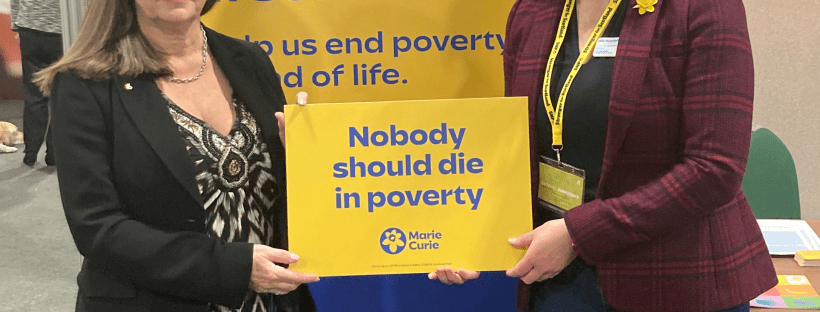
MSP MEETS WITH MARIE CURIE TO DISCUSS CAMPAIGN TO END POVERTY AT THE END OF LIFE
Research by Marie Curie and Loughborough University Centre for Research in Social Policy has examined the number of people who die in poverty in Scotland, and across the UK, each year, and how the risk of being in poverty at the end of life varies for different groups.
According to their studies, people of working age in Scotland who are terminally ill are at a high risk – with over a quarter of this group dying in poverty.
Terminally ill people with dependent children are also more likely to experience poverty at the end of life than those without children.
This makes those who die at working age more than twice as likely to die in poverty than those who live past pension age.
For the latest year when statistics are available, around 8,200 people died in poverty in Scotland – of which an estimated 150 lived in South Lanarkshire.
The charity is calling on the UK and Scottish governments, as well as local authorities, to implement a range of measures to help terminally ill people who are struggling with the cost of living at the end of their lives.
Some of their asks include:
- Deliver a social tariff which supports terminally ill people’s needs through a whole-system approach, including working with energy providers to commit to increasing targeted energy support for terminally ill people in the upcoming Government budgets
- Include terminally ill people in the eligibility for any increased support from the Warm Homes Discount this winter
- Local authorities to prioritise people with a terminal illness for Discretionary Housing Payments to help them
- Allow terminally ill people of working age to be eligible for the State Pension.
Rutherglen MSP Clare Haughey recently met with Marie Curie to learn more about their campaign.
Commenting, Ms Haughey said:
“It was a pleasure to meet with Marie Curie to learn more about their campaign about ending poverty for those at the end of their lives.
“Being diagnosed with a terminal illness and reaching the end of life sadly increases a person’s risk of falling below the poverty line.
“With unprecedentedly high energy costs, soaring mortgage rates, and ever-increasing food bills, Marie Curie are absolutely correct that terminally ill people, their families and carers need support.”
Ellie Wagstaff, Senior Policy Manager, Marie Curie in Scotland, added:
“This research is sobering and has truly laid bare the extent of poverty at the end of life in Scotland. Being terminally ill and reaching the end of life can substantially increase a person’s risk of experiencing poverty, and decades of structural inequality has been a driving factor in one in four working age people, and one in eight pensioners in Scotland, dying in poverty at the end of life.
“The ‘double burden’ of income loss and increased costs brought on by a terminal illness can leave people struggling to make ends meet, and force those who were already on the threshold, below the poverty line, especially terminally ill people with dependent children.
“There is an urgent need for systematic reform from Scottish Government and Westminster to ensure that terminally ill people, their families and carers are not faced with unprecedented financial hardship in the final years, months, weeks, days and hours of their lives. This will require a whole-system approach, collaboration and transformative leadership on national and local levels.”
ENDS
 Clare Haughey